Zero-days were the work of months. Now they are the work of minutes.
Zero-days were once rare. They were the product of months of manual effort, elite skill, and patient research. Mythos proves that is no longer true.
Mediocre attackers can now operate at elite levels. Discovery is faster than ever. Exploitation is faster than disclosure. The gap between the two, the gap that every modern security program is built around, is collapsing in real time.
This is the world security tools have to operate in now. Not the one they were designed for.
Every assumption needs to be reconsidered. Especially the ones built on patching.
The dominant model has been scan, prioritize, patch. It was already strained. AI-enabled attackers have broken it.
You cannot win a race when your opponent moves at machine speed and you move at change-management speed. The math has changed. The strategy has to change with it.
- Reachability is necessary, not sufficient.
- Detection without prevention is a backlog with a dashboard.
- Runtime is the only timeline attackers cannot outpace.
The technical reality
Runtime protection has been promised before. Previous attempts failed.
RASP saw too much and understood too little. Latency, false positives, crashed applications. Most teams turned it off within months.
Cloud security vendors added response capabilities, but kill-the-container is a blunt instrument. It cannot see inside the application. It cannot know what code is running. It cannot tell when that code starts doing something it should not.
The result: runtime blocking exists in product demos. Almost no one runs it in production. The risk of breaking the app outweighs the risk of the vulnerability.
The missing piece was always context.
Backlog grows faster than you remediate.
One technique blocked. Application uninterrupted.
Oligo was built to defend against attackers that move at AI speed.
We were founded in 2022, when everyone else was pushing agentless. We knew the world was heading somewhere static scanners couldn't follow. That world has arrived.
See running code at the function and syscall level. In production. Without source access.
Oligo's runtime sensor captures execution telemetry at the function and syscall level, in real time, in production, without requiring source code access. By observing code as it runs, Oligo can tell the difference between what an application is supposed to do and what an attacker is trying to make it do. Static scanners, network tools, and infrastructure-layer controls cannot make that distinction.
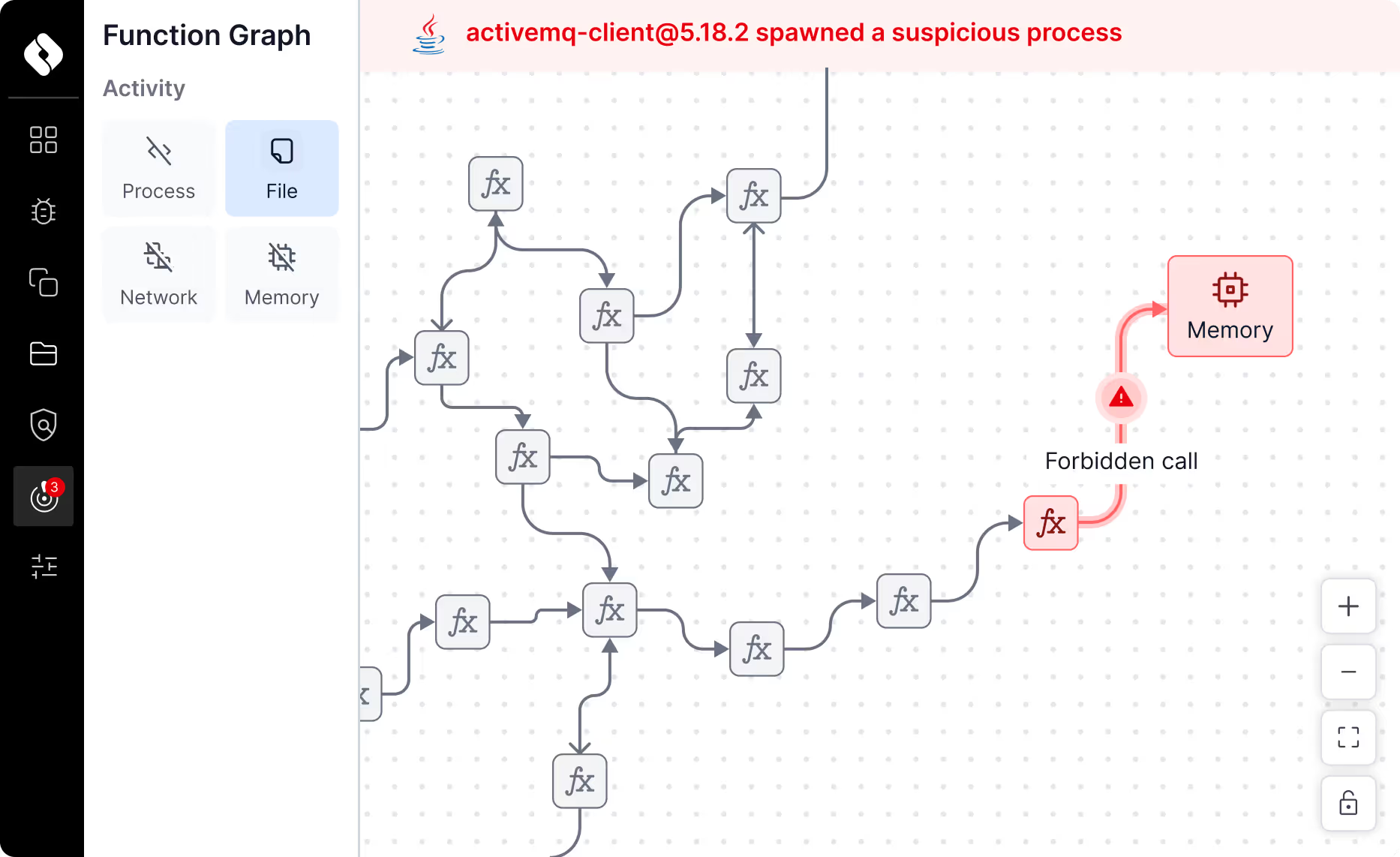
Stop exploits inside the application. Without disrupting uptime.
Oligo correlates application-layer function calls with OS-level syscalls. A specific sequence indicates an exploit attempting to execute. Neither element is malicious in isolation. The combination is. When Oligo detects the pattern, it blocks the syscall directly from the kernel. The attack stops. The application keeps running.
Application call stack
OS-level syscall
Protection scales. Patching doesn't.
A single Oligo blocking rule for insecure deserialization covers more than 100 HIGH and CRITICAL Java CVEs and 80+ Python CVEs in an average cloud environment. One rule. When the next deserialization vulnerability is disclosed next month, organizations running Oligo are already protected.
Technique-based protection closes entire attack surface classes rather than chasing individual vulnerabilities. It is the only model that can keep pace with AI-accelerated discovery.
And the patch backlog you still have
Oligo uses Deep Application Inspection to identify which vulnerable components actually execute, highlight the vulnerabilities that are reachable in real flows, and de-prioritize the noise. Teams patch the risk that is real in their environment, instead of patching everything in alphabetical order.